USE FOR-SINCE-YET-ALREADY
USE FOR-SINCE-YET-ALREADY


EXERCISES:
YET / ALREADY
For/since
The words for and since are used in sentences where the speaker wants to talk about something that started in the past and continues into the present.
For is used when specifying the amount of time (how long):
- I've had this watch for more than 40 years.
- I've only known her for a few weeks.
- He's been here for 6 months and still can't speak a word of German.
- She's been smoking for a long time. No wonder she coughs so much!
Since is used when specifying the starting point:
- I've had this watch since 1965.
- I've only known her since the beginning of last week.
- He's been here since April and he still can't speak a word of German.
- She's been smoking since she started grade 5. No wonder she coughs so much!
Note: The present perfect or present perfect continuous are needed in such sentences. It is wrong to say:
- I know her for two years.
- I know her since 2006.
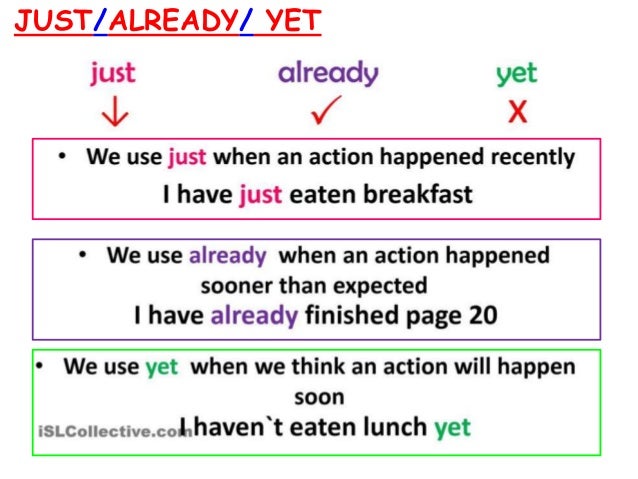
ALREADY
Already is used to show that something has happened earlier. It is used in the mid-position of the sentence and is usually used with Present Perfect.
In American English, it is also possible to use already with the Simple Past.
Already in a sentence:

British English:
- I have already done my homework.
- He has already washed the car.
American English:
- I already did my homework.
- He already washed the car.
YET
Yet is used to talk about something that is expected to happen, but did not happen till this moment.
Yet means at any time up to now.
Yet is used in interrogative (questions) and negative sentences.
Yet is usually used with Present Perfect. Yet is used in the end of the sentence.
Yet means at any time up to now.
Yet is used in interrogative (questions) and negative sentences.
Yet is usually used with Present Perfect. Yet is used in the end of the sentence.
Yet in a sentence:
- Have you finished your homework yet? – Interrogative
- I haven’t washed my car yet. – Negative
Yet is very rarely used in affirmative sentences, but when it is used, it implies a negative.
For example,
- I have yet to read the ‘Harry Potter and the Goblet of Fire’ book
= I have not read the ‘Harry Potter and the Goblet of Fire’ book yet, but I will probably read it soon.
YET / ALREADY
1 - I was tired, ___ I managed to finish it.
2 - Have you ____ finished?
3 - As ___, I haven't has time to call her.
4 - He has ____ to start the project.
5 - Have they arrived ___?
6 - Have they ____ finished?
7 - I was shocked that they had ____ done it.
8 - I was surprised that they had ___ to decide what to do.
9 - She has ___ to arrive.
10 - He has ___ arrived.
11 - I had ____ had enough.
GOOD LUCK! ♥


Comentarios
Publicar un comentario